
Has the AI Bubble Burst? Why Companies Are Hiring Again
Advertisement
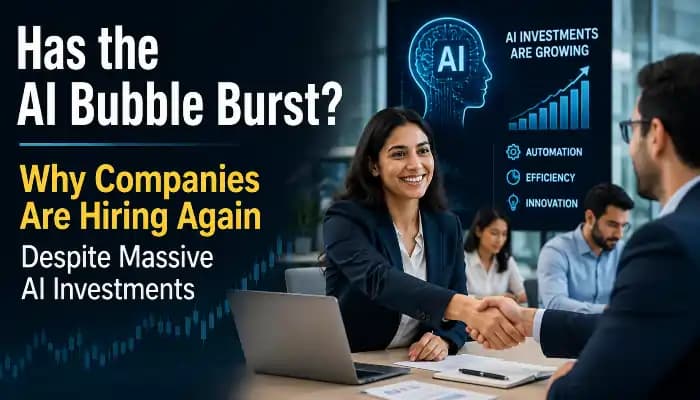

This raises an important question: Has the AI bubble burst?
Advertisement
The short answer is no. What we are witnessing is not the collapse of AI, but a shift from AI hype to AI reality.
Companies such as Cognizant, Infosys, and Walmart are not abandoning AI. Instead, they are recognizing that while AI can automate tasks, it cannot replace the full spectrum of human capabilities. Organizations are increasingly realizing that:
- AI can automate certain tasks, but not entire jobs.
- AI initiatives require skilled professionals to implement, monitor, and improve them.
- Productivity gains from AI are often more modest than the aggressive forecasts made between 2023 and 2025.
- Customers continue to value human judgment, creativity, relationship management, and accountability.
Why Companies Are Hiring Again
Advertisement
Several organizations that initially anticipated significant workforce reductions through AI have discovered a different reality.
While AI can increase productivity, it also generates additional work related to oversight, quality assurance, compliance, and decision-making. Businesses have also found that customers often prefer human interaction when dealing with complex issues or sensitive situations.
Moreover, excessive automation can negatively impact service quality if implemented without adequate human involvement. As a result, many organizations are selectively increasing hiring while continuing to invest in AI technologies.
The Great AI Reality Check
Advertisement
During 2023 and 2024, many executives viewed AI primarily as a cost-reduction tool. The expectation was that generative AI would automate large portions of knowledge work and significantly reduce dependence on human employees.
Today, organizations are discovering that while AI can automate tasks, it struggles to replace entire job functions.
According to the World Economic Forum’s Future of Jobs Report 2025, employers increasingly expect collaboration between humans and machines rather than complete automation. By 2030, work is projected to be distributed more evenly across people, technology, and human-machine collaboration models.
The report estimates that while 92 million jobs could be displaced globally, approximately 170 million new jobs may be created, resulting in a net gain of 78 million jobs worldwide.
These findings suggest that workforce transformation is less about job elimination and more about job evolution.
Companies Are Not Abandoning AI
Some observers interpret renewed hiring activity as evidence that organizations are pulling back from AI. However, the broader evidence suggests otherwise.
Major enterprises continue to expand AI deployments at scale. Microsoft’s Copilot rollout across leading Indian IT services firms, including Infosys, TCS, and Wipro, has surpassed 300,000 licenses, making it one of the largest enterprise AI implementations globally.
The goal is not to replace employees, but to integrate AI into daily workflows and enhance productivity.
Similarly, Microsoft’s 2025 Work Trend Index found that organizations are increasingly adopting hybrid human-AI teams, where AI agents handle routine tasks while employees focus on strategic thinking, creativity, decision-making, and customer engagement.
The message is clear: companies are investing in both AI and people.
Why Human Talent Still Matters
As organizations deploy AI in real-world environments, its limitations are becoming more apparent.
AI systems can summarize information, generate content, analyze data, and automate repetitive processes. However, they still struggle with contextual understanding, ethical judgment, relationship management, accountability, and complex decision-making.
This is particularly evident in industries such as healthcare, financial services, legal operations, education, and human resources, where trust, compliance, and accuracy are critical.
Consequently, many organizations have adopted “human-in-the-loop” models, where AI assists with execution while humans remain responsible for oversight and final decisions.
The outcome is not fewer humans, but different and often more valuable human roles.
The Quiet Rollback of AI Projects
Another emerging trend is what analysts describe as “AI pruning.”
Organizations are increasingly reviewing AI initiatives that fail to demonstrate measurable business value. Rather than abandoning AI altogether, they are scaling back projects with unclear returns while expanding those that deliver tangible outcomes.
This pattern is common in every major technology cycle.
The internet experienced it. Cloud computing experienced it. Digital transformation experienced it.
AI is now entering a similar phase, where practical applications survive and scale while speculative initiatives gradually fade away.
Hiring Continues Despite AI Advancement
Perhaps the strongest evidence against the “AI replaces everyone” narrative is that many organizations continue to hire aggressively.
Companies increasingly recognize that AI tools require skilled professionals to design, supervise, validate, govern, and improve their outputs.
In many cases, AI-driven productivity gains are enabling organizations to take on more work, expand services, and pursue new opportunities rather than simply reducing headcount.
The Future Belongs to AI-Enabled Professionals
The debate is often framed incorrectly as “AI versus humans.”
A more accurate perspective is “humans with AI versus humans without AI.”
The World Economic Forum identifies AI literacy, analytical thinking, technological skills, creativity, resilience, and leadership among the fastest-growing workforce capabilities.
As a result, employers are investing heavily in reskilling and upskilling initiatives to prepare their workforce for an AI-enabled future.
The professionals most likely to succeed will be those who combine domain expertise with the ability to leverage AI effectively.
Conclusion
AI is not disappearing, and the AI bubble has not burst. What is fading is the belief that AI alone can replace the human workforce.
The next phase of AI adoption will be defined by collaboration rather than substitution. Organizations are learning that technology delivers the greatest value when combined with human judgment, creativity, empathy, and accountability.
The future of work is unlikely to be fully automated. Instead, it will be shaped by companies that successfully combine the strengths of intelligent machines with the unique capabilities of human talent.
Note: We are also on WhatsApp, LinkedIn, and YouTube to get the latest news updates. Subscribe to our Channels. WhatsApp– Click Here, YouTube – Click Here, and LinkedIn– Click Here.
About the Author
SightsIn Plus
SightsIn Plus is an India’s leading high-quality people-focused monthly HR Magazine and provides up-to-date HR News, Leadership Announcements, Best HR Practices and Insights by Global CHROs, CEOs, HR Advisors, Business Managers and HR Heads on topics of interest to HR professionals. To subscribe SightsIn Plus, HR Magazine please visit- https://sightsinplus.com/subscribe/
View all articles by SightsIn Plus →