
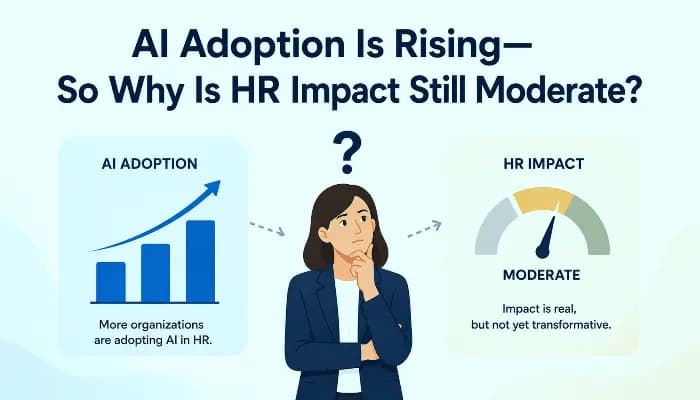
AI Adoption Is Rising—So Why Is HR Impact Still Moderate?
Advertisement

A comprehensive benchmark study titled “AI ADOPTION IN HR – 2026: From Experimentation to Impact” was released by Sightsin Plus, HR Magazine.
Advertisement
It reveals that corporate human resource divisions are transitioning away from localized pilots toward integrated, data-driven automation.
The State of AI Adoption
The extensive survey outlines that 61% of polled organisations have formally implemented Artificial Intelligence within their HR operational architecture, and 39% organisation are yet to implement AI in HR.
Despite this strong majority, mature deployments remain rare.
Advertisement
Nearly half of the businesses surveyed (46.51%) classify their AI capabilities as strictly “emerging”.
Meanwhile, 20.93% are operating in early-stage pilot phases, 18.6% are actively expanding their footprints, and a meager 13.95% boast fully integrated, scaled corporate structures.
Dominance of Automated Hiring
Talent Acquisition remains the primary driver of implementation, with a staggering 77% of organizations deploying AI to streamline candidate sourcing and tracking systems.
Other key segments lag significantly behind recruiting: Performance Management accounts for 21.39%, followed closely by Learning & Development (21.4%), Employee Experience (19.27%), and core HR Operations (19.27%).
Advertisement
Strategic, long-range Workforce Planning remains the least automated domain at just 10.71%.
AI in Hiring: Business Impact and Cultural Bottlenecks
While early adopters highlight massive speed advantages, the financial return remains measured.
Over half of the participants (56.58%) categorize AI’s organizational influence as “moderate,” while 23.68% observe no tangible workflow impact whatsoever.
High-yield, “transformational” outcomes were reported by only 6.58% of enterprises.
This performance barrier is directly tied to internal capabilities.
Respondents cite a deficit in internal talent as the leading barrier, with 56.94% naming a “lack of skills” as their primary operational bottleneck.
Other challenges include localized budget constraints (18.05%), unyielding legacy systems or executive resistance (15.27%), and poor fundamental data quality (9.72%).
Industry Variations
AI deployment remains highly uneven across sectors.
The IT and Technology sector predictably commands the landscape with an 89% adoption rate.
The BFSI (Banking, Financial Services, and Insurance) sector follows closely at 78%.
Healthcare maintains a strong deployment level at 66%.
Conversely, traditional industries struggle to pivot; Manufacturing sits at 52%, Energy at 55%, and Construction anchors the bottom tier at just 30%.
Commenting on the report, Romesh Srivastava, Editor-in-Chief, SightsIn Plus, said, “Talent Acquisition and Learning & Development are emerging as the leading areas of AI adoption within Human Resources.”
He added, “While organizations have started deploying AI across multiple HR functions, adoption is still at an evolving stage rather than a mature one. As a result, most companies continue to report only a moderate impact of AI on HR outcomes, indicating significant potential for deeper integration and value creation in the years ahead.”
Romesh Further said, “The impact of AI on HR remains moderate because most organizations are still using AI for incremental improvements rather than end-to-end transformation. While adoption is expanding across HR functions, challenges related to data, integration, governance, and skills continue to slow the realization of AI’s full potential.”
Note: We are also on WhatsApp, LinkedIn, and YouTube to get the latest news updates. Subscribe to our Channels. WhatsApp– Click Here, YouTube – Click Here, and LinkedIn– Click Here.
About the Author
Sahiba Sharma
Sahiba Sharma, Senior Editor - Content at SightsIn Plus
View all articles by Sahiba Sharma →