
IIT Graduate Rejects 90% Pay Cut Internship, Sparks Debate
Advertisement


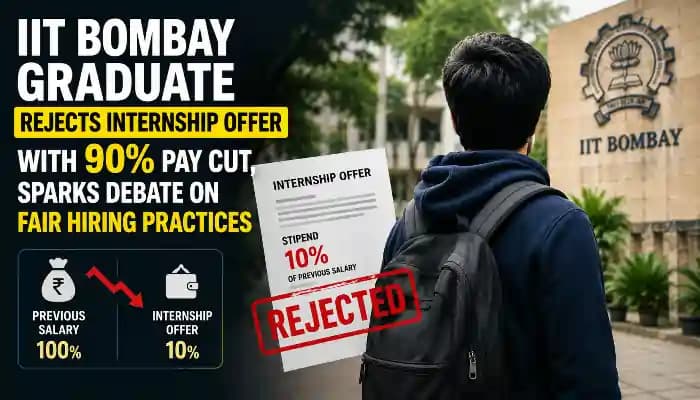

A viral social media post by IIT Bombay graduate and software professional Soham Nayak has reignited discussions around compensation fairness, hiring ethics, and the growing use of internship-based employment models for experienced talent.
Advertisement
Viral Post Brings Recruitment Practices Under Scrutiny
Soham recently shared a discussion with a recruiter who approached him with what initially appeared to be a promising opportunity.
However, the conversation quickly took an unexpected turn when he was informed that the role would begin with a three-to-six-month internship despite requiring the same skills, experience, and responsibilities he had previously handled in full-time positions.
The most surprising aspect, according to Soham, was the compensation. The internship reportedly offered only 10% of his previous salary.
Advertisement
Got a call from an HR yesterday.
He asked my current salary. I told him.
Then he offered me a "3–6 month internship period" before the actual job.
At 1/10th of the pay I just told him.
Not a junior role. Not a different stack. The same work I ship every day, relabeled as an…
“The Easiest No”
Sharing his experience in his post, Soham wrote that despite being unemployed for more than two weeks and actively seeking opportunities, he had no hesitation in rejecting the proposal.
He argued that accepting such a drastic pay reduction would effectively devalue years of professional experience and set an unhealthy precedent for both employers and job seekers.
Advertisement
The post quickly gained traction, attracting thousands of views and comments from professionals across the technology industry.
Professionals Rally Behind the Decision
Many users praised Soham for standing his ground.
One commenter wrote, “Companies cannot expect experienced professionals to perform full-time work while being compensated like interns. That’s not upskilling—it’s cost-cutting.”
Another user remarked, “The market may be difficult right now, but a 90% reduction for the same work is impossible to justify.”
A third commenter highlighted a broader concern, saying, “These practices hurt not only individual candidates but also distort salary benchmarks across the industry.”
A Reflection of Current Market Challenges?
While most reactions supported Soham’s decision, some professionals noted that the current hiring environment remains highly competitive, leading some candidates to accept lower-paying roles as a temporary measure.
Industry observers point out that organizations are increasingly experimenting with contract, internship, and probationary hiring models to manage costs amid economic uncertainty and fluctuating demand in the technology sector.
However, experts argue that such arrangements should be accompanied by fair compensation and clearly defined learning opportunities, particularly when experienced professionals are involved.
The Bigger Question: Where Should Companies Draw the Line?
The incident has sparked a broader conversation about whether internship programs should be reserved primarily for students and fresh graduates rather than being used as an entry point for seasoned professionals.
As organizations continue to balance business realities with talent acquisition needs, the episode serves as a reminder that compensation remains one of the strongest indicators of how employers value experience and expertise.
For many professionals following the discussion, Soham’s response was not simply about salary—it was about protecting the long-term value of one’s skills in an increasingly competitive job market.
Note: We are also on WhatsApp, LinkedIn, and YouTube to get the latest news updates. Subscribe to our Channels. WhatsApp– Click Here, YouTube – Click Here, and LinkedIn– Click Here.
About the Author
SightsIn Plus
SightsIn Plus is an India’s leading high-quality people-focused monthly HR Magazine and provides up-to-date HR News, Leadership Announcements, Best HR Practices and Insights by Global CHROs, CEOs, HR Advisors, Business Managers and HR Heads on topics of interest to HR professionals. To subscribe SightsIn Plus, HR Magazine please visit- https://sightsinplus.com/subscribe/
View all articles by SightsIn Plus →