
AI is Creating a ‘Darwinian Moment’ for Employees, Says Palo Alto CEO
Advertisement
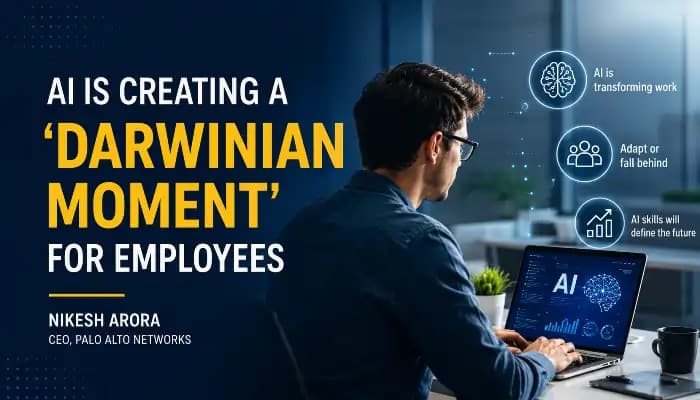

Artificial intelligence is rapidly changing workplace expectations, and employees who fail to adapt risk being left behind, according to Palo Alto Networks CEO Nikesh Arora.
Advertisement
Speaking on the 20VC podcast, Nikesh described the current phase of AI adoption as a “Darwinian moment” for the workforce, saying companies are increasingly looking for employees who can effectively work with AI rather than those relying solely on traditional skills.
AI Skills Becoming Essential
Nikesh said nearly 90% of employees in large enterprises are still not “AI savvy,” highlighting what he sees as one of the biggest challenges facing businesses today.
Advertisement
He added that there are no formal education programmes that can fully prepare workers for the fast-changing AI landscape, making self-learning and continuous upskilling essential.
According to him, employees will need to take greater responsibility for developing AI skills, as organisations cannot rely solely on conventional training methods to bridge the knowledge gap.
Those who adapt quickly will be better positioned to grow in their careers, while others could struggle as AI becomes more deeply integrated into everyday work.
Companies Rethinking Workforce Strategy
Nikesh’s remarks come at a time when several technology companies are slowing hiring and restructuring their workforces as AI automates routine tasks.
Advertisement
He pointed to companies that have significantly reduced headcount while rebuilding teams with employees who possess stronger AI capabilities.
Also Read: AI Hiring Defies the IT Downturn: Report
However, Palo Alto Networks is taking a different route. Instead of large-scale layoffs, the cybersecurity company is allowing natural employee attrition and replacing departing workers with AI-skilled talent.
He said the company has increasingly relied on hackathons to identify and recruit technical professionals who are comfortable working with AI technologies.
Nikesh expects this approach to gradually increase the proportion of AI-ready employees across the organisation over the next few years.
AI Will Change Jobs, Not Eliminate Them
While Nikesh believes AI will reduce the need for larger teams in functions such as marketing, human resources and finance by improving employee productivity, he does not see AI leading to fewer jobs overall.
Instead, he expects demand to rise for engineers, cybersecurity experts, AI specialists, and sales professionals who can use AI effectively.
His comments reflect a broader shift across the technology industry, where AI proficiency is increasingly becoming a key requirement for career growth.
As businesses invest more in AI, workplaces face a Darwinian moment where adaptability, continuous learning, and upskilling are essential for employees to stay relevant and competitive.
Note: We are also on WhatsApp, LinkedIn, and YouTube to get the latest news updates. Subscribe to our Channels. WhatsApp– Click Here, YouTube – Click Here, and LinkedIn– Click Here.
About the Author
Sheetal Singh
Sheetal Singh, Senior News Journalist, SightsIn Plus
View all articles by Sheetal Singh →