
Campus Hiring Picks Up in 2026 as Fresher Demand Gains Momentum
Advertisement
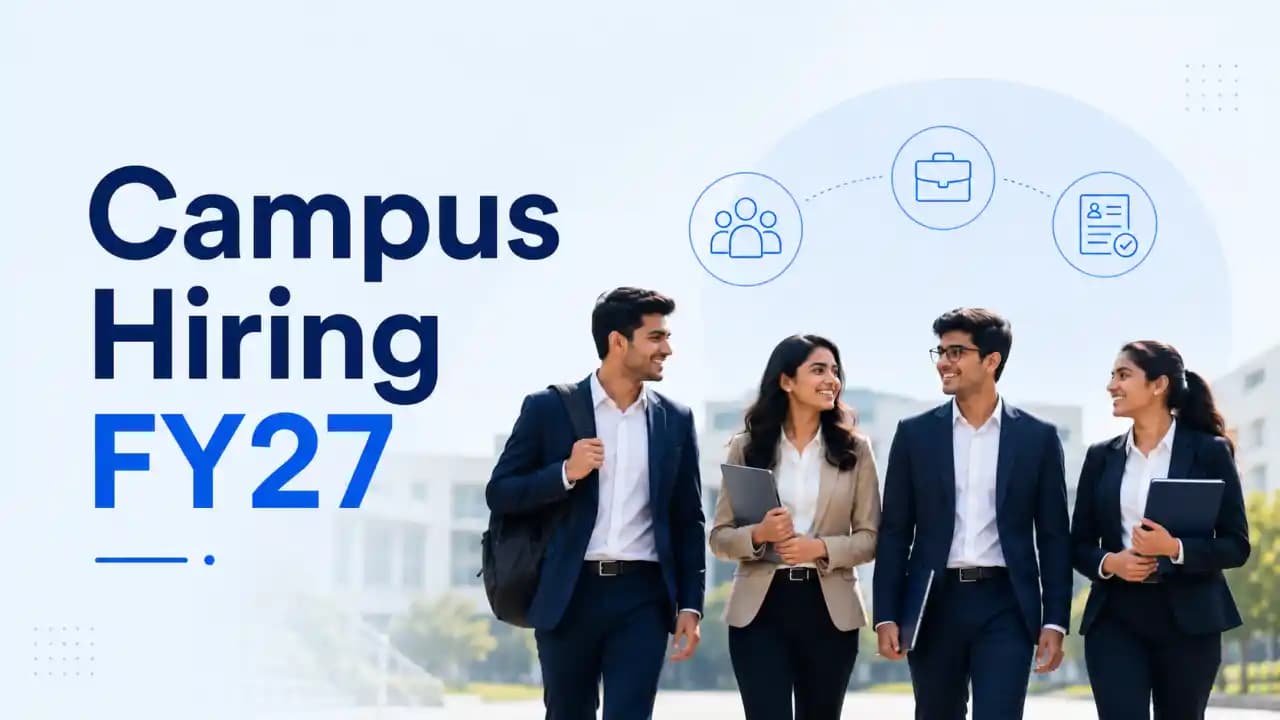

After a relatively subdued campus hiring season in 2025, fresher recruitment is showing signs of improvement in 2026. Colleges are reporting earlier recruitment activity, while IT services companies, start-ups, GCCs and core industries are expanding their presence on campuses.
Advertisement
The improvement is particularly visible among large IT services companies, which had taken a more cautious approach to campus recruitment over the past couple of years.
Key Campus Hiring Trends in 2026
- TCS: Around 25,000 campus offers have already been made, with the company remaining on track to hire about 40,000 freshers annually.
- Infosys: Plans to hire around 20,000 college graduates in FY27.
- Cognizant: Targeting 24,000–25,000 fresh graduates in 2026, around 20% higher than its 2025 intake.
- Start-ups and GCCs: Colleges are reporting a wider recruiter base beyond traditional IT services companies.
- Internships to PPOs: More students are converting internships into full-time employment, particularly at start-ups.
IT Hiring Shows Signs of Recovery
Advertisement
In conversation with BusinessLine, Philip Praveen, COO of Rajalakshmi Engineering College, said nearly half of the college’s placements had taken place in June and July, suggesting that hiring activity has started earlier this year.
He also reported a higher share of better-paying technology roles. At TCS, around 65% of the offers were reportedly at the Digital and Prime levels, with packages ranging from ₹7 lakh to ₹12 lakh per annum. This figure is based on the college’s placement data and could not be independently verified.
TCS has made around 25,000 campus offers and has indicated that it remains on track to hire about 40,000 freshers annually. The 25,000 figure should therefore be viewed as the offers made so far rather than the final FY27 hiring target.
Infosys has also reiterated its plan to hire around 20,000 college graduates in FY27. Cognizant is targeting 24,000–25,000 fresh graduates this year, compared with about 20,000 in 2025.
Advertisement
The pickup comes after a period of cautious hiring across the technology sector. Industry observers believe improved visibility around business demand and client spending is allowing large service companies to rebuild their entry-level talent pipelines.
AI Skills Matter, But Job Profiles Remain Similar
While artificial intelligence is increasingly appearing in campus hiring requirements, colleges say the basic job profiles have not changed dramatically.
Vikas Misra, Vice-Chancellor of Hindustan Institute of Technology and Science, said demand continues to centre on:
- Software development
- Data and analytics
- Cloud technology
- Cybersecurity
- AI-enabled technology roles
The difference is that students are now expected to understand and use AI tools along with their core technical skills.
This is also encouraging companies to look at fresh graduates differently. Rajesh Kumar, Co-founder of Kalvium and FACE Prep, said large service companies are moving towards greater “juniorisation” of their workforce, with AI-enabled freshers becoming an important part of their talent strategy.
Start-ups, GCCs and Core Sectors Add to Hiring
Campus recruitment is no longer dependent only on traditional IT services companies.
Colleges are seeing greater participation from start-ups, GCCs, manufacturing companies and engineering firms. HITS expects start-ups to account for around one-third of its hiring this season and is targeting a placement rate of about 90%, compared with around 80–85% last year.
Core engineering streams are also benefiting from increased activity in areas such as semiconductors, manufacturing, aerospace and aviation.
“Semiconductor and manufacturing companies are beginning to come in now. It is a good mix of smaller start-ups, GCCs and large firms like L&T,” Praveen said.
Misra also reported demand for aerospace and aviation talent, with companies such as Boeing and Air India participating in campus hiring, while space start-ups are also recruiting.
The growth of semiconductor manufacturing and data-centre infrastructure is creating additional opportunities for electronics and communication engineering graduates and other technical disciplines.
Internship-to-Job Route Gains Ground
Another important change this year is the growing role of internships in campus recruitment.
At HITS, around 30% of students placed so far have reportedly received their offers through the internship-to-pre-placement offer (PPO) route.
Start-ups, in particular, are increasingly using internships to assess students before making full-time offers.
The trend gives students an additional route into the workforce while allowing employers to assess practical skills before making a permanent hiring decision.
A Gradual Recovery, Not Yet a Full Hiring Boom
The 2026 campus season indicates a gradual recovery in fresher recruitment rather than a complete return to the high hiring levels seen during earlier IT hiring cycles.
Large IT services companies are increasing fresher intake, while start-ups, GCCs and core industries are widening the recruiter pool. At the same time, employers are looking for graduates who combine strong technical fundamentals with AI familiarity, practical projects and internship experience.
For students, the message is clear: AI skills are becoming important, but strong fundamentals, coding, data, cloud, cybersecurity and hands-on experience continue to matter.
About the Author
Sheetal Singh
Sheetal Singh, Senior News Journalist, SightsIn Plus
View all articles by Sheetal Singh →