
Gen Z Doesn’t Want to Become Managers: What HR Leaders Are Seeing?
Advertisement

For many years, becoming a manager has been seen as the natural next step in a person’s career. But this may be changing, especially among younger employees.
Advertisement
Gen Z employees are increasingly becoming an important part of the workforce and are continuing to grow within the workplace. By 2030, Gen Z is expected to make up 30% of the global workforce, potentially reshaping traditional ideas about career growth, leadership, and management.
But HR leaders are seeing less interest in traditional management roles, as younger employees increasingly explore alternative paths for professional growth, greater autonomy, and career development.
To understand this change, SightsIn Plus surveyed HR leaders to ask whether they are seeing less interest among Gen Z employees in becoming managers.
The survey received 120 responses. Of these, 75 HR leaders (62.5%) said Yes, and 45 (37.5%) said No.
Advertisement
This means nearly two out of every three HR leaders surveyed are seeing less interest among Gen Z in becoming managers. However, more than one-third are not seeing the same trend in their organisations.
The numbers show a clear difference in what HR leaders are observing. But the responses also suggest the issue may not be as simple as Gen Z not wanting to lead.
Gen Z May Not Be Rejecting Leadership
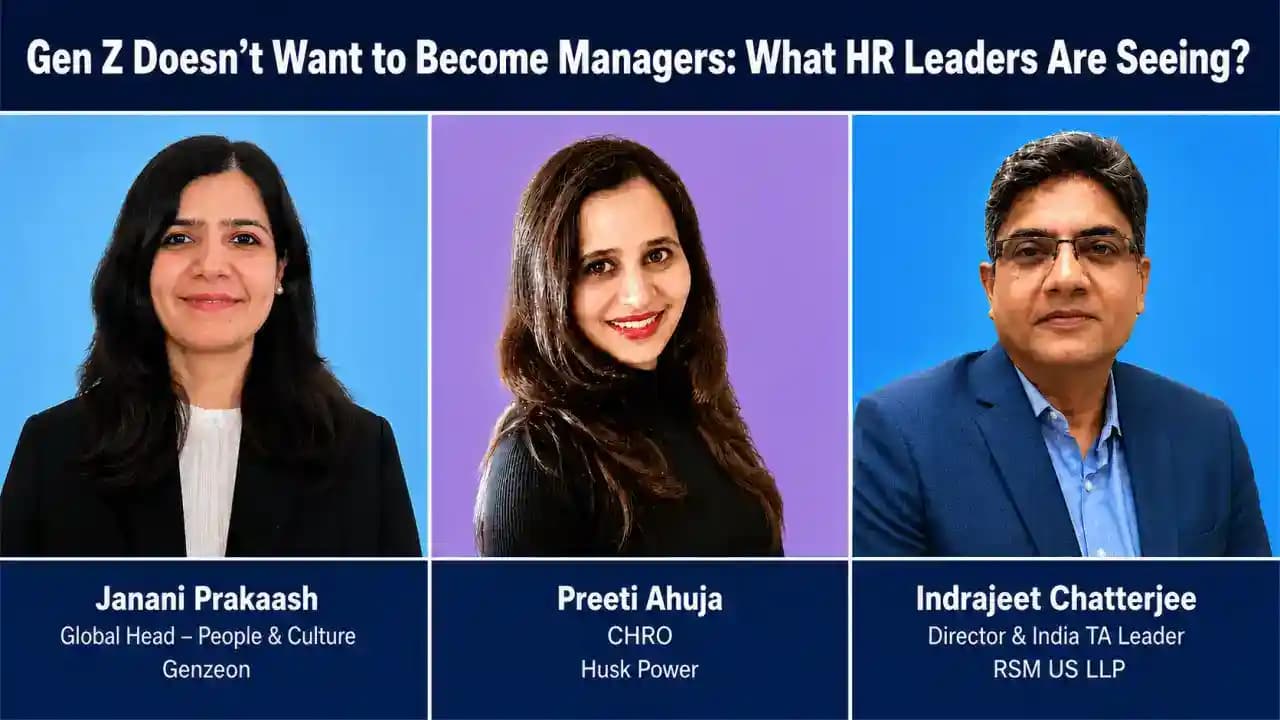
Preeti Ahuja, CHRO, Husk Power, believes Gen Z is not moving away from leadership but from a particular kind of leadership.
Advertisement
Preeti Ahuja, CHRO, Husk Power said-
Gen Z isn’t turning away from leadership. They’re turning away from a specific type of leadership. They want to lead in ways that align with their values—through expertise, collaboration, and personal growth. This is where “Conscious Unbossing” comes in. It is not a rejection of ambition or leadership; it is a deliberate choice to step away from the traditional management track when it is perceived as responsibility without power.
Gen Z is challenging organisations to rethink whether management is still the only—and most meaningful—path to leadership and career growth.
Gen Z has had a front-row seat to what management looks like today. They have watched managers navigate restructuring, absorb pressure and take accountability for decisions they may not control. They have also seen the impact of workload, burnout, emotional labour and work-life erosion. The concern is therefore not responsibility itself—it is responsibility without authority, accountability without decision rights, and pressure without adequate protection or reward.
They are turning away from a particular model of leadership, not leadership itself. They want to create impact through expertise, collaboration, autonomy and personal growth rather than relying primarily on hierarchy or title. For them, leadership is increasingly about influence and agency, not simply managing people.
Organisations need to redesign leadership rather than simply persuade Gen Z to accept traditional management roles. Accountability must come with authority, decision-making power and support. Organisations should also create credible expert and specialist career paths and provide opportunities to lead through projects, expertise and collaboration. The bigger opportunity is to involve Gen Z in reimagining leadership for the 21st century.
Preeti’s opinion points to one possible reason behind the survey results. Some young employees may not be against taking responsibility. Instead, they may question whether becoming a manager gives them enough authority, freedom, and support to do the job well.
Management Is No Longer the Only Career Path
Indrajeet Chatterjee, Director & India TA Leader, RSM US LLP, also sees some Gen Z employees showing less interest in traditional management roles. However, he does not see this as a lack of ambition.
Indrajeet Chatterjee, Director & India TA Leader, RSM US LLP, said-
I do see some Gen Z employees being less interested in traditional management roles, but I would not interpret this as a lack of ambition or leadership potential. Rather, they are more intentional about how they define success and growth.
Many young professionals today see people management as one of several career paths rather than the default next step. They are often attracted to opportunities where they can create impact through expertise, innovation, problem-solving, and project leadership before taking on formal people management responsibilities.
In my view, this reflects a shift in how leadership is perceived. Gen Z is not rejecting leadership; they are redefining it. They value flexibility, continuous learning, and meaningful work, and many want to build deep expertise before leading teams.
Organisations should adapt by offering multiple career pathways, including both people leadership and specialist tracks. Providing opportunities to lead projects, mentor others, and influence business outcomes can help develop leadership capability without requiring an immediate move into management.
The question is not whether Gen Z wants to lead. The question is whether organisations are willing to evolve their definition of leadership. Those that do will build stronger, more diverse leadership pipelines for the future
His comments point to a change in the way career progression is viewed. An employee may want to grow, take on bigger responsibilities and have more influence without immediately becoming a manager.
Also Read: Beyond the Bell Curve: A Radical, AI-led Reimagination of Performance Management in Enterprises
For companies, this could mean creating career paths where employees can grow as specialists as well as people managers.
Many Gen Z Employees Are Still Exploring
Janani Prakaash, Global Head – People & Culture, Genzeon, sees another reason why some Gen Z employees may not be ready to commit to management.
Janani Prakaash, Global Head – People & Culture, Genzeon said-
In my experience, many Gen Z employees are still figuring out whether they want to stay in one career path at all. They see their professional lives as a large canvas, where interests can evolve and different possibilities remain open. Committing to a long-term management track can feel premature in a world where careers are becoming more fluid, skills are changing rapidly, and AI is reshaping assumptions about the future of work.
The COVID period added another layer of difficulty. Many who entered the workforce then missed the informal apprenticeship of observing live role models—how experienced managers handle conflict, ambiguity and relationships. At the same time, organisational loyalty has weakened, as employees have watched companies adopt hire-and-fire approaches whenever roles or skills are seen as less relevant. Naturally, the psychological contract has become more transactional.
I do believe Gen Z has leadership aspirations. But they do not want to be subservient, nor do they want to lead through hierarchy and status. Many have seen managers who, despite rising from difficult circumstances themselves, continue to operate through level differences—and that model does not resonate with them. They are more willing to follow authority built on competence and transparency than on designation alone.
Organisations must respond by offering credible role models, diverse career pathways, and management roles defined by trust, purpose and autonomy—not just hierarchy.
The future may not be about fewer leaders, but about redefining what leadership means.
Janani’s comments highlight another factor: many young employees are still deciding what they want from their careers. For them, committing to a management path early may feel like closing off other options.
What HR Can Take From the Survey
The survey does not show that Gen Z has lost interest in career growth. Instead, the responses from HR leaders suggest that the traditional route to career growth may be changing.
With 75 out of 120 HR leaders saying they see less interest in management roles, companies may need to look more closely at why young employees are hesitant to become managers.
The reasons can vary. Some may want to develop their technical or professional skills first. Others may prefer project leadership or specialist roles. Some may also have concerns about the workload and pressure that come with managing people.
At the same time, the 45 HR leaders who said No show that this trend is not visible everywhere. This could mean that organisational culture, the nature of the work, the manager’s role and the opportunities available to employees all have a part to play.
For HR teams, the answer may not be to push Gen Z employees into management. Instead, companies can give them opportunities to lead projects, mentor colleagues, develop expertise and take responsibility before they decide whether people management is right for them.
The survey also raises a basic question for organisations: Is becoming a manager still the only way to show that an employee has grown?
The views shared by the three HR leaders suggest that it may not be.
Gen Z may still want to lead, but some employees want to lead through knowledge, projects, influence and expertise rather than only through a designation.
If companies recognise these different paths, they may be able to keep more young talent interested in leadership while also giving them more choice in how they grow.
About the Author
SightsIn Plus
SightsIn Plus is an India’s leading high-quality people-focused monthly HR Magazine and provides up-to-date HR News, Leadership Announcements, Best HR Practices and Insights by Global CHROs, CEOs, HR Advisors, Business Managers and HR Heads on topics of interest to HR professionals. To subscribe SightsIn Plus, HR Magazine please visit- https://sightsinplus.com/subscribe/
View all articles by SightsIn Plus →