
India’s Economy Could Hit $7 Trillion This Decade, Boosting Jobs
Advertisement


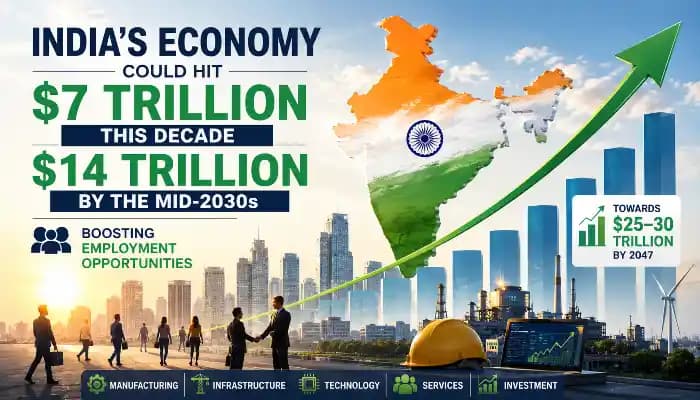

India is on course to become a $7 trillion economy by the end of this decade, with the potential to double in size to nearly $14 trillion by the mid-2030s, according to India’s Ambassador to the United States, Vinay Mohan Kwatra.
Advertisement
The projection reflects the country’s long-term growth trajectory, driven by economic reforms, infrastructure development, rising domestic demand, and increasing global investments.
Speaking at the IX USISPF Leadership Summit 2026, Kwatra said India, currently a $4.3 trillion economy, is steadily moving toward becoming one of the world’s largest economic powers.
He also reiterated the country’s long-term aspiration of becoming a $25-30 trillion economy by 2047, marking 100 years of India’s independence.
Strong Growth Outlook
Advertisement
India has remained one of the fastest-growing major economies despite global economic uncertainty. Continued public investment in infrastructure, expansion of the manufacturing sector, digital transformation, and policy reforms have strengthened the country’s economic fundamentals.
The government’s focus on initiatives such as production-linked incentives (PLI), ease of doing business, and investment in logistics and industrial corridors has also supported growth.
Kwatra noted that India’s expanding economy positions it as a reliable partner in the global supply chain while creating new opportunities for businesses and investors.
India-US Trade Ties Gain Momentum
Advertisement
The summit also highlighted growing economic cooperation between India and the United States.
US Ambassador to India Sergio Gor said both countries are making steady progress toward an interim trade agreement. While negotiations involve thousands of products and legal provisions, he expressed confidence that both sides are moving closer to a mutually beneficial deal.
Stronger bilateral trade could further boost investments, exports, and business collaboration across sectors including manufacturing, technology, clean energy, and defence.
What It Means for Employment
A larger economy is expected to create significant employment opportunities across industries.
Rising investments in manufacturing, infrastructure, construction, logistics, renewable energy, electronics, semiconductors, automotive, financial services, healthcare, and information technology are likely to increase demand for skilled professionals as well as frontline workers.
As companies expand production capacity and global businesses strengthen their presence in India, hiring is expected to rise across engineering, operations, supply chain, project management, digital technologies, sales, and support functions. The growth of Global Capability Centres (GCCs) and exports could also generate new high-value jobs.
However, experts believe that sustaining employment growth will require continued investment in skilling, vocational training, digital literacy, and industry-ready talent. Bridging skill gaps will be critical to ensuring that India’s workforce can meet the demands of a rapidly expanding economy.
Looking Ahead
If India maintains its current growth momentum, the country could emerge as one of the world’s leading economic engines over the next decade.
Alongside higher incomes and stronger business activity, the projected economic expansion has the potential to accelerate job creation, improve workforce participation, and strengthen India’s position as a global investment and employment destination.
Note: We are also on WhatsApp, LinkedIn, and YouTube to get the latest news updates. Subscribe to our Channels. WhatsApp– Click Here, YouTube – Click Here, and LinkedIn– Click Here.
About the Author
Sheetal Singh
Sheetal Singh, Senior News Journalist, SightsIn Plus
View all articles by Sheetal Singh →