
Extreme Heat Threatens Jobs Across Indian Cities: World Bank
Advertisement


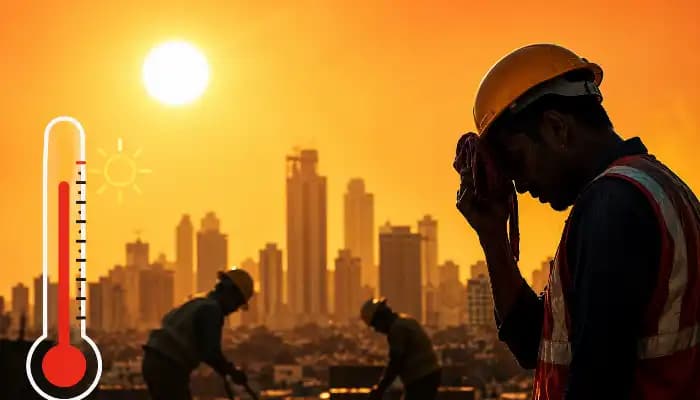

Indian cities could face significant job losses over the coming decades as rising temperatures and extreme heat reduce the number of safe working hours, according to a new World Bank report.
Advertisement
The World Bank report is titled ‘A Livable Future: Protecting Jobs and Growth from Extreme Heat in South Asia’s Cities.’
The study warns that outdoor work is rapidly becoming unsafe, which will severely depress labor productivity, lower worker earnings, and discourage capital investment across South Asian metropolises.
Projections for Key Indian Metros
Across South Asia, extreme heat already wipes out the equivalent of 31 million full-time jobs annually. Without proactive climate adaptation measures, rising temperatures could shrink the regional economy by nearly 7% by 2050—at a time when South Asia is set to add 280 million working-age people.
Advertisement
Indian megacities will be among the hardest hit by heat-related working-hour losses:
- New Delhi: Projected to lose the equivalent of 266,000 full-time jobs by 2030 due to unsafe outdoor working conditions, rising to 418,000 by 2050 and over 629,000 by 2080.
- Kolkata: Expected to lose 360,000 job-equivalents by 2030, swelling to 391,000 by 2050.
- Mumbai: Estimated job-equivalent losses stand at 204,000 by 2030 and 255,000 by 2050.
- Chennai: Facing labor productivity losses equivalent to 141,000 jobs by 2030 and 145,000 by 2050.
Secondary urban centers are also feeling the burn. Patna is projected to see one of the sharpest spikes in unsafe working hours—rising from 2.4% in 2030 to 6.3% by 2080—while Jaipur’s unsafe hours will nearly double from 1.5% to 2.9%.
Infrastructure and Human Impact
Advertisement
Workers in sectors such as construction, logistics, manufacturing, transport, sanitation and street vending are expected to be among the most affected because their jobs require prolonged exposure to high temperatures
The report highlights that extreme heat extends far beyond labor productivity, straining critical infrastructure. Temperatures exceeding 40°C trigger power outages that are 20% to 50% more frequent and last up to 60% longer.
Furthermore, Delhi’s Indira Gandhi International Airport is projected to experience temperatures near or above 50°C for multiple days annually by 2030, potentially forcing airlines to limit passenger and cargo weight due to reduced air density.
The human cost also remains drastically understated, as heat-related fatalities are frequently attributed to cardiac or renal failure rather than heatstroke.
The report cites research linking a single five-day heatwave in India to approximately 30,000 excess deaths.
$1.6 Trillion Economic Opportunity in Sustainable Cooling
The World Bank emphasises that investments in heat resilience can substantially reduce these risks.
Recommended measures include expanding urban green spaces, strengthening heat action plans, improving access to cooling infrastructure, redesigning work schedules, and deploying early warning systems.
According to the report, every $1 invested in heat early warning systems could generate nearly $50 in economic benefits by helping protect workers, businesses, and local economies from the impacts of extreme heat.
India’s sustainable cooling market is projected to reach $1.6 trillion by 2040, driven by demand for energy-efficient air conditioning, green building design, and urban heat-resilient infrastructure.
Additionally, local heat early-warning systems yield a massive return on investment, generating approximately $50 in economic benefits for every $1 spent.
Note: We are also on WhatsApp, LinkedIn, and YouTube to get the latest news updates. Subscribe to our Channels. WhatsApp– Click Here, YouTube – Click Here, and LinkedIn– Click Here.
About the Author
Sheetal Singh
Sheetal Singh, Senior News Journalist, SightsIn Plus
View all articles by Sheetal Singh →