
DRDO Opens Applications for Paid Quantum Technologies Internship
Advertisement

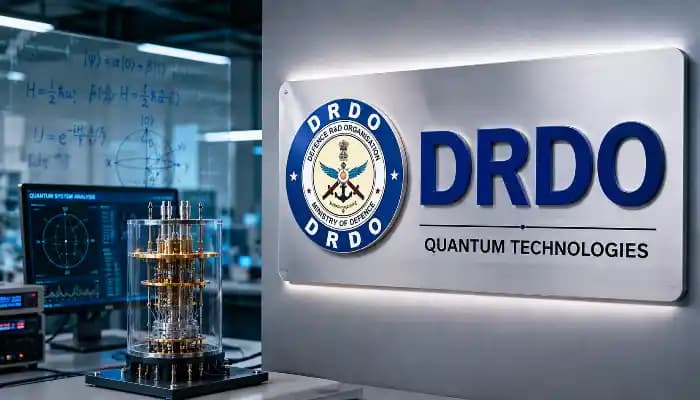

The Defence Research and Development Organisation (DRDO) has invited applications for its Paid Internship Scheme 2026 at the Defence Young Scientist Laboratory – Quantum Technologies (DYSL-QT), Pune.
Advertisement
The internship offers engineering and science students an opportunity to work with DRDO scientists on advanced research projects in quantum technologies and related domains.
The programme is designed to provide practical research exposure to students pursuing undergraduate and postgraduate studies while contributing to projects that support India’s defence technology ecosystem.
Selected interns will work at DYSL-QT, a specialised DRDO laboratory focused on quantum technologies for strategic and defence applications.
Advertisement
Who Can Apply?
The internship is open to students pursuing B.E./B.Tech, M.E./M.Tech, M.Sc. or equivalent programmes from recognised universities and institutes.
Applicants must fulfil the eligibility criteria mentioned in the official notification and obtain a recommendation from the Head of their institution before applying.
Students from disciplines such as Quantum Computing, Quantum Communication, Quantum Sensing, Physics, Electronics, Computer Science, Artificial Intelligence, Cyber Security, Photonics, Mathematics, Materials Science and related engineering fields are encouraged to apply.
The internship will allow participants to gain hands-on experience by working on live research projects under the guidance of DRDO scientists.
Advertisement
Besides strengthening technical knowledge, the programme will help students understand how emerging technologies are being developed for defence and national security.
Paid Internship, Selection Process and Benefits
DRDO has clarified that this is a paid internship. The stipend, duration and other terms will be governed by the internship guidelines mentioned in the official advertisement. However, selection for the internship will not guarantee employment with DRDO after completion of the programme.
Applications will be shortlisted based on academic performance, eligibility, availability of research projects and the laboratory’s requirements. Only shortlisted candidates will be contacted for further communication.
The internship offers an excellent opportunity for students interested in research careers, higher education, quantum technologies and defence innovation to work in one of India’s leading research organisations.
How to Apply and Last Date
Candidates need to submit their applications in the prescribed format along with all supporting documents.
The application should include self-attested copies of academic mark sheets, a recent passport-size photograph, Aadhaar or another valid identity proof, and a recommendation letter from the Head of the Institution.
The completed application form should be sent through Speed Post or Registered Post to the address mentioned in the official notification:
The Director
Defence Young Scientist Laboratory – Quantum Technologies (DYSL-QT)
DRDO, Hall No. 1, Ground Floor, Vigyan Upakendra, DIAT Campus, Girinagar, Pune – 411025, Maharashtra.
Applications sent by email or received after the closing date will not be considered.
Last Date to Apply: 20 August 2026. Please check the notification copy for more information.
About DRDO
The Defence Research and Development Organisation (DRDO), under the Ministry of Defence, is India’s premier defence research agency.
It develops advanced technologies for the Army, Navy and Air Force across areas including missiles, aeronautics, naval systems, electronics, artificial intelligence, cybersecurity, space systems and quantum technologies, playing a key role in strengthening India’s defence capabilities and promoting self-reliance in defence technology.
Note: We are also on WhatsApp, LinkedIn, and YouTube to get the latest news updates. Subscribe to our Channels. WhatsApp– Click Here, YouTube – Click Here, and LinkedIn– Click Here.
About the Author
SightsIn Plus
SightsIn Plus is an India’s leading high-quality people-focused monthly HR Magazine and provides up-to-date HR News, Leadership Announcements, Best HR Practices and Insights by Global CHROs, CEOs, HR Advisors, Business Managers and HR Heads on topics of interest to HR professionals. To subscribe SightsIn Plus, HR Magazine please visit- https://sightsinplus.com/subscribe/
View all articles by SightsIn Plus →